Thursday, 2 January 2014

Why does our consciousness change from devotional to sensual?


By Chaitanya Charan das

Question: At one moment we are absorbed in devotional thoughts and then suddenly at the next moment we become submerged in sensual, even immoral, thoughts. Why is spiritual life so unstable?

Answer: It is not spiritual life that is unstable; it is we who are unstable in our spiritual life. And our instability is due to our having not yet recognized the gravity of gravity in spiritual life.

The gravity force in spiritual life

The force of gravity is a simple, real, undeniable fact of existence. If we neglect this force, we will naturally, obviously, inevitably be pulled down by it and will fall to disaster.
Material desires comprise a similar gravity force that acts on us by dragging our consciousness down to the material level. If we neglect this force, our consciousness will naturally, obviously, inevitably, be pulled down by it to sensual contemplations, and we will fall from our devotional standards to disaster.

The difference between these two gravity forces is not so much in how they act on us as in how we react to them. Our recognition of the reality of the gravity force that acts on physical objects is default and deep-rooted, so we take the necessary precautions instinctively. If we are standing and need to be seated, we don’t lower ourselves into thin air; we lower ourselves onto a chair.

However, our recognition of the reality of the gravity force that acts on our consciousness is usually casual and superficial, so we rarely take the necessary precautions instinctively. If we are doing a devotional activity that absorbs ourselves in remembrance of Krishna and need to engage in a worldly obligation, we rarely think whether that activity will preserve our devotional consciousness; we just start doing it. Metaphorically speaking, we shift from a standing position to a sitting position without checking whether there is a chair to sit on. No wonder then that the gravity force of our habitual material desires starts immediately acting on us and pulling us towards worldly indulgences. Consequently, our consciousness that was at one moment peaceful, even blissful, becomes at the next moment turbulent, even malevolent. The cause for this disconcerting change is straightforward: gravity.

Generating an anti-gravity force

If we don’t’ wish to be pulled down, we need to first contemplate on the reality and the gravity of this gravity force. This contemplation will impel, even compel, us to take seriously the Bhagavad-gita’s direction (8.7) to keep remembering Krishna even while doing our worldly activities. Remembering Krishna generates an upward anti-gravity force that can not only arrest our fall but can also propel us up.

We may wonder: how can we do both these things – remember Krishna and do our worldly duties - simultaneously? It is an art that we learn by practice and experience. Foundationally, learning the art requires an authentic and pervasive devotional intention, wherein we truly want to offer our full heart, our whole life, our entire being to Krishna. When this honest and fervent intention permeates our very existence, then all our activities – even our worldly obligations – will have a devotional purpose. Thereby we will be able to meditate on how the particular activity that we are doing is connected to Krishna, indeed, is meant for Krishna. This meditation will keep our consciousness at the spiritual level – or at least somewhere near it.

Of course, a life-defining devotional intention doesn’t appear automatically overnight; it needs to be carefully nurtured to maturity. For most of us at present, this intention is likely to be in a nascent stage. To ensure that it grows smoothly and swiftly, we need to invest adequate time in core spiritual activities that nourish us with divine happiness and thereby strengthen our devotional intention. These core spiritual activities include chanting, hearing and studying scriptures, engaging in Deity worship and rendering direct devotional service.
Investing adequate time in core spiritual activities doesn’t mean only weekend visits to spiritually vibrant temples or occasional pilgrimages to energizing holy places. It also means diligent engagement in our daily morning spiritual practices or sadhana. This sadhana acts as a daily generator of an anti-gravity force that counters the unavoidable effects on our consciousness of our worldly engagements.  Our daily worldly activities expose us to material desires that pull our consciousness down towards materialism. In protecting contrast, our daily devotional practices engender within us spiritual desires that pull our consciousness up towards Krishna. If we don’t engage in sadhana daily, then we will have no force to counter or even check the gravity force of our default material desires. Consequently, we will fall freely, quickly, disgracefully to sensuality and immorality. Even if we engage in daily sadhana, but don’t engage in it diligently – if we engage in it ritualistically or mechanically or perfunctorily just to get it over with, then such sadhana will not generate an adequate upward force to cancel out the downward force. We will therefore undergo a slow downward fall that may eventually terminate in devotional misfortune. Our daily sadhana needs to be so intense that it generates a sufficient upward force, sufficient to not only reverse the daily downward motion but to also slowly but surely push us upwards closer and closer to Krishna.

Spiritualizing our worldly obligations

In addition to our daily sadhana, we need to spiritualize our remaining day as much as possible. Most of us can’t engage in directly devotional activities throughout our entire day – or even for a majority of the day. We spend much of our daily time in professional, familial or bodily activities. Though these activities may not be in themselves spiritual, they are still spiritualizable.

While trying to spiritualize these activities, we need to take a vital, indispensable precautionary measure: stay away from, or at least minimize contact with, stimuli that exert an overwhelming gravity force on our consciousness. These stimuli will vary depending on our specific history of past lapses and indulgences. We need to carefully ensure that we don’t unwittingly allow that black past to darken our present and future. If, despite our best efforts, we somehow get subjected to these provocative stimuli, we need to have an emergency action plan ready to counter their insidious effects. This action plan – which is essentially our personal SOS call to Krishna – can include earnest chanting, heartfelt praying, contemplating on an illuminating scriptural passage, recollecting an inspiring spiritual experience or contacting a trustworthy spiritual mentor or devotee-friend.
On a more positive note, the means for spiritualizing our worldly activities range over a broad spectrum that can include the following:

1.Having, whenever possible, a background devotional stimulus like spiritual music or a picture of Krishna or a fellow devotee as our work-partner
2.Taking, whenever practical, periodic short breaks to remind ourselves of our devotional purpose
3.Consciously offering to Krishna at their starting and ending those worldly activities whose nature and pressure makes it difficult to remember him while doing them.

There is no set standard formula for how each one of us can remember Krishna. This is not a deficiency, however. It is a facility, an opportunity to exercise our individuality and creativity within the scriptural framework for the practice of Krishna consciousness. Because all of us are unique and the worldly circumstances in which we function are also unique, we will need to improvise and innovate to find the ways that work best for us in preserving our devotional consciousness. If we show Krishna the sincerity and intensity of our desire to remember him, he will guide us, as he promises in the Bhagavad-gita (10.10).  His guidance may come in the form of penetrating insights that enable us to see demonstrations of his teachings even in worldly events. Or it may come in the form of ideas and techniques by which we can remember him more and better while being externally engaged in worldly activities. Or it may come in many other ways – all of which make life in Krishna consciousness unpredictably exciting.

To summarize, by carefully cultivating remembrance of Krishna, we will not only prevent its dangerous yo-yo-like swings but will also preserve its steady upward trajectory towards Krishna.

Tuesday, 8 October 2013

Kali-yuga : Age of forgetting God


Prabhupada: Yes. Everywhere. This is the age of forgetting God. We say it is Kali-yuga. Kali-yuga means the age of misunderstanding. And that is, I said, dirty things within the heart. So God is so powerful that if we chant the holy name of God, then we become purified. So our movement is based on this principle, chant the holy name of God. We give all facilities to everyone without any distinction that "You come with us. Come in our temple, chant Hare Krsna mantra, and take little prasadam, refreshment, and gradually you become purified." So if the government authorities give us facilities for this business, that we hold mass sankirtana, Hare Krsna, and give them little prasadam, then we are sure the whole place will change.

Friday, 4 October 2013

Daily Deity Darshan from around the world!


Meditating always on Krishna


Back to Godhead Magazine #25 (Part three)

A Study in Mysticism
By His Divine Grace A.C. Bhaktivedanta Swami

An explanation of the mystic techniques offered by the great
Teachers of Vedic wisdom—and their value to contemporary man.

The Goal of Transcendental Meditation

In The Bhagavad Gita, the Sanskrit word "Mam" is frequently used. This word means "unto me." Krishna, the Supreme Personality of Godhead says, "unto Me" -- Krishna. We cannot interpret this in a different way. When I say, "Bring me a glass of water," it means that I am the person in want of the glass of water, and if you supply to me and not to others, then it is right. When Krishna says, "unto Me," that means Krishna. But philosophers are still interpreting -- they say "unto something else." Even grammatically this is wrong.

One who has developed attachment to Krishna is Krishna conscious. They say if you have attachment for your lover you always think of her. That is lover consciousness. It is natural. It is stated that a woman who has another lover besides her husband shows herself very attentive to her household duties, but is always thinking, "When shall my lover and I meet in the night?" This is an example: It is possible, in spite of our false engagement, if we love somebody, to think of him always. If materially it is possible, why not spiritually? That is the whole teaching of The Bhagavad Gita.

>>> Ref. VedaBase => The Goal of Transcendental Meditation

Thursday, 3 October 2013

Anti-material and Devotion


Easy Journey to Other Planets

By His Divine Grace A.C. Bhaktivedanta Swami

Antimatter as Devotion

This eternally existing antimaterial world is nonmanifested to the material scientist. He can at best only have information of its existence as being contrary to the modes of material Nature. Full details of the antimaterial realm can be known only from those infallible sources, the liberated authorities who have thoroughly realized the constitution of the antimaterial principle.

This information of the antimaterial world is therefore had by the aural reception of a submissive disciple of the Personality of Godhead. The Vedas or the Vedic knowledge was thus imparted into the heart of Brahma, the first living being in the created material world, and Brahma educated the great saint Narada in this transcendental wisdom.

So it is also with The Bhagavad Gita. The philosophy of the Gita was spoken by the Personality of Godhead long, long ago to the presiding deity of the Sunglobe, and when such knowledge was misinterpreted by breaking the chain of authoritative aural reception, it was repeated by the Personality of Godhead on the battlefield of Kurukshetra. At this time Arjuna took the place of Brahma and of the Sun god to receive transcendental knowledge from Sri Krishna. In order to drive out the misgivings of the gross materialist, Arjuna asked all relevant questions about the Lord, and all relevant answers were given by the Lord to the full satisfaction of a layman.

Those who are too captivated by the glamor of the material world cannot accept the authority of Lord Sri Krishna on account of their polluted life and unclean habits. Therefore, one has to become thoroughly clean in habit and heart before one can understand the details of the antimaterial world. And Bhakti Yoga -- which means the process of purification by devotional service, as enunciated in the Gita -- is the detailed and scientific program of spiritual activity for all beings, from the beginner neophyte to the highest perfection of the line.

The details of the antimaterial world are many times more extensive than the details of the material world. The material world is only a shadow representation of the antimaterial, and intelligent men who are clean in heart and habit will be able to know the facts about the spiritual sphere from the texts of The Bhagavad Gita, Srimad Bhagwatam and similar Vedic scriptures.

The basic points of antimaterial knowledge areas follows: The presiding Deity of the antimaterial world is Sri Krishna, the original Personality, as well as His expansions into many plenary portions. Such Personalities of Godhead can be known only by antimaterial activities, commonly called Bhakti Yoga or devotional service.

The Personality of Godhead is the Supreme Truth and He is the whole antimaterial principle. Material principles as well as antimaterial principles are emanations from His Person. He is the root of the complete tree. When water is poured onto the root of a tree the branches and leaves of the tree develop automatically. And in the same way when Sri Krishna, the Personality of Godhead, is worshiped, all the details of all the worlds are given into the heart of the devotee, without laboring in the materialistic way. This is the secret message of The Bhagavad Gita.

Swan of My Mind - Prayers by King Kulashekara


Nitai Pada Kamala

Prayers of King Kulasekhara

Mukunda Mala StotraVerse 33

The Swan of My Mind

Audio


krsna tvadiya-pada-pankaja-panjarantam
adyaiva me visatu manasa-raja-hamsah
prana-prayana-samaye kapha-vata-pittaih
kanthavarodhana-vidhau smaranam kutas te

O Lord Krsna, at this moment let the royal swan of my mind enter the tangled stems of the lotus of Your feet. How will it be possible for me to remember You at the time of death, when my throat will be choked up with mucus, bile, and air?
NITAI PADA KAMALA

Audio

Purport to Prayers of King Kulasekhara
By His Divine Grace A.C. Bhaktivedanta Swami Prabhupada
This verse, prayer, is taken from one book known as Mukunda-mala-stotra. This prayer was offered by one king whose name was Kulasekhara. He was a great king, at the same time a great devotee. There are many instances in the history of Vedic literature that the kings were very great devotees, and they are called rajarsis. Rajarsis means: although they are on the royal throne, they are all saintly persons. So this Kulasekhara, King Kulasekhara, is praying to Krsna that "My dear Krsna, the swan of my mind may now be entrapped with the stem of your lotus feet. Because, at the point of death, the three elements of bodily functions, namely the mucus, and the bile, and the air, they will overlap, and there will be a choking in the voice, so I shall not be able to utter your sweet Holy Name at the point of my death.'' The comparison is given in this way, that the white swan, whenever it finds a lotus flower, it goes there and sports by diving into the water and entangling him in the stem of the lotus flower. So King Kulasekhara wants that in the healthy stage of his mind and body, he may be immediately entangled with the stem of the lotus feet of the Lord and die immediately. The idea is that one should take to Krsna consciousness while his mind and body is in good condition. Do not wait for the last stage of your life. Just go on practicing Krsna consciousness while your body and mind is in a healthy state, and then at the time of death you shall be able to remember Krsna and His pastimes and be immediately transferred to the spiritual kingdom.

>>> Ref. VedaBase => CD 14-6 (02:51 Min.)  Purport to Prayers of King Kulasekhara

At the Final Hour of Death - Lessons from life of Ajamila


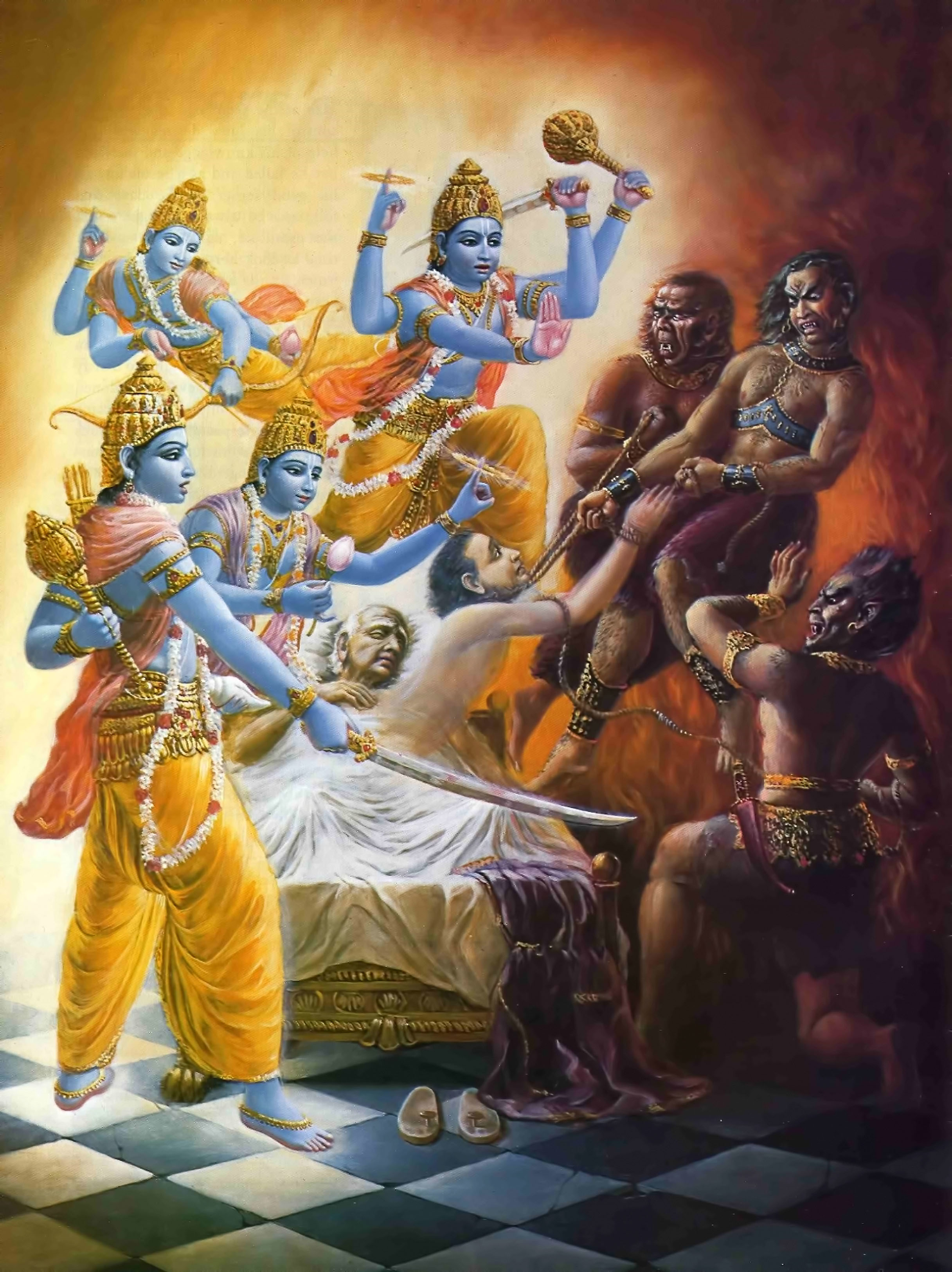
Sukadeva Gosvami continued: Ajamila then saw three awkward persons with deformed bodily features, fierce, twisted faces, and hair standing erect on their bodies. With ropes in their hands, they had come to take him away to the abode of Yamaraja. When he saw them he was extremely bewildered, and because of attachment to his child, who was playing nearby, Ajamila began to call him loudly by his name. Thus with tears in his eyes he somehow or other chanted the holy name of Narayana. (Srimad-Bhagavatam 6.1.28-29)

Anxious to Save Themselves from Death

At the time of death people become very anxious to save themselves, especially those who have been sinful. Of course, the soul itself is not subject to death (na hanyate hanyamane sarire [Bg. 2.20]), but leaving the present body and entering into another body is very painful. At death the living entity can no longer bear to remain in his present body -- the pain is so acute. Sometimes when a person's life becomes too painful he commits suicide. But suicide is a sin punishable by the laws of karma.

When Ajamila was dying, he saw three ferocious and very frightening persons with ropes in their hands, unruly hair on their heads, and bodily hair like bristles. These assistants of Yamaraja, the Yamadutas, had come to drag Ajamila out of his body and take him to the court of Yamaraja. Sometimes a dying man cries out in fear when he sees the Yamadutas. Ajamila, too, became very fearful.

Fortunately, even though Ajamila was referring to his son, he chanted the holy name of Narayana, and therefore the order-carriers of Narayana, the Visnudutas, also immediately arrived there. Because Ajamila was extremely afraid of the ropes of Yamaraja, he chanted the Lord's name with tearful eyes. Actually, however, he never meant to chant the holy name of Narayana; he meant to call his son.

>>> Ref. VedaBase => SC 4: Neither Birth Nor Death

Submissiveness - A necessary quality of a Devotee


Bhagatji comes into the kitchen in Prabhupada's back garden every lunchtime to cook Prabhupada's chapatis. He is very expert at this and when I was learning to cook Prabhupada had me learn chapati making from him. Prabhupada likes Bhagatji very much, and so when Bhagatji brings the last chapati into the prasadam room for Prabhupada, he lets him sit and chats with him until the end of his meal.

I told Bhagatji today about my decision to not do any special vrata for Karttika. He was surprised and tried to cajole me into continuing, stressing that one must observe some special vrata in order to get the benefit of Karttika. But I held my ground. I told him that the observance of the vrata was useless if it meant I couldn't do my service to Srila Prabhupada. He conceded that it was a higher principle and relented.

Bhagatji also frequently attends managerial meetings and Prabhupada's afternoon darsanas. This afternoon at about 4:00 p.m. he brought some news about Nitai. He told Srila Prabhupada that he has been seen in Vrndavana with Yogananda dasa. Bhagatji was good friends with Nitai, and out of sentiment, he pleaded with Srila Prabhupada to allow him to bring Nitai to see him. He thought that if Srila Prabhupada could personally talk to him, he could straighten him out.

Prabhupada dismissed his request without prolonged discussion on the matter. "No. Unless he is prepared to come of his own accord, then what will be the use? Unless a man is submissive, then it is useless to speak with him."

>>> Ref. VedaBase => TD 4-5: Sri Vrndavana-dhama

Just continue chanting!


Just keep chanting Hare Krishna and moving the beads and focus on listening to the syllables of the Holy Names. As the mind wanders, we shouldn’t get agitated. Just keep chanting; don’t give up the process and eventually the mind cooperates."

HH Radhanatha Swami

Holy Name week special!